TECHNOLOGY
The quiet art of lubrication
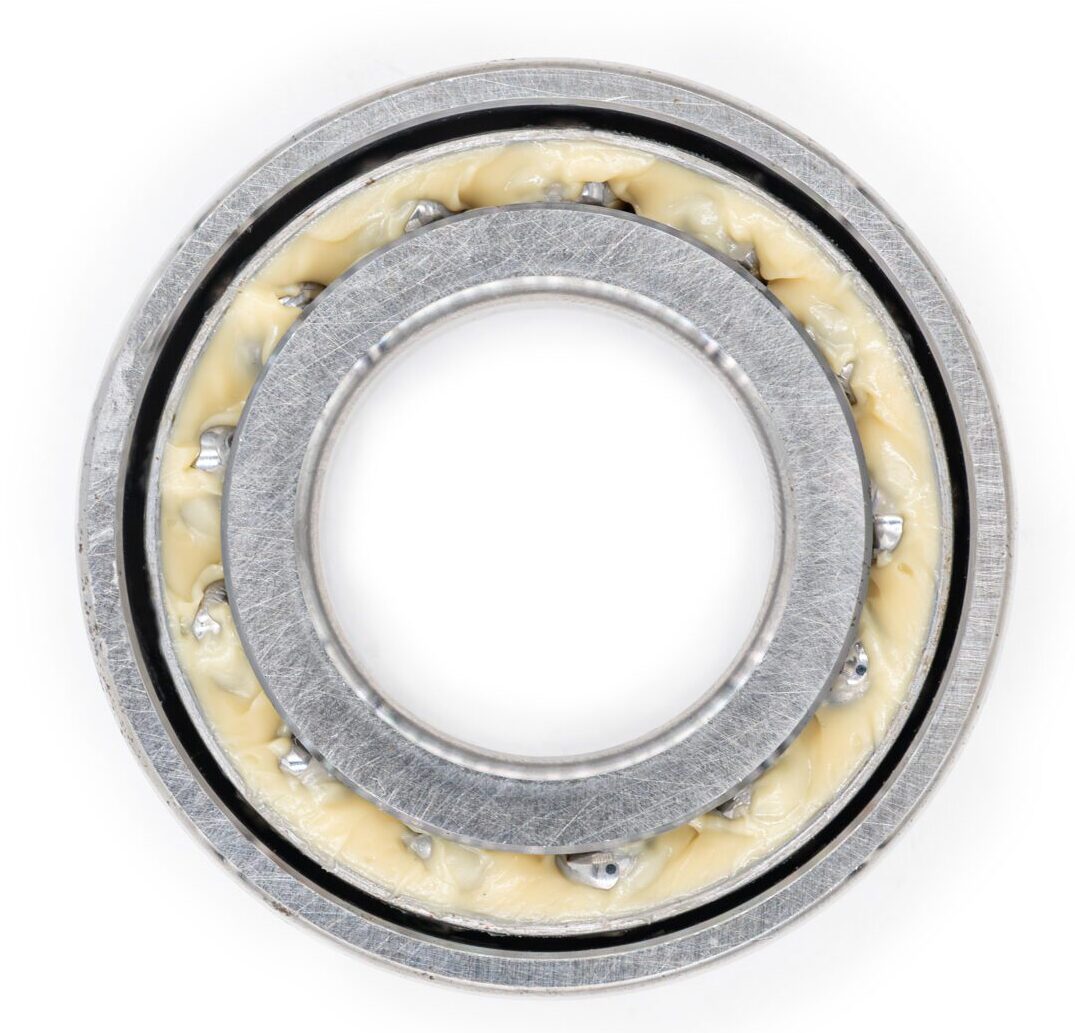
It starts off innocently enough. You turn on your computer in the morning. Instead of the usual gentle hum, you hear a slight scratching sound. A faint sense that “that sounded different yesterday.” You ignore it. Later, in the car, the ventilation is running, but something isn’t quite right. A soft hum that wasn’t there yesterday. No big deal. Not yet. At home in the evening: the refrigerator. Suddenly, it’s humming louder. Or higher-pitched. Or just different.
These noises can be caused or influenced by incorrect or missing lubricants. Noises are telltale signs. They indicate that something isn’t running quite right somewhere inside. And often, the cause isn’t a major defect—it’s in the details. It’s the lubricant. For this situation, BECHEM offers lubricants that minimize or eliminate these noises.
“
„In many rotating components, the rolling bearings determine the sound.“
DR. AXEL FIGGE
“In many rotating components, the rolling bearings determine the noise level. They rotate at very high speeds and, when lubricated with the right lubricant, operate quietly. To meet these extreme demands, very high-quality, noise-reducing greases with extremely low friction are used,” explains Dr. Axel Figge,
Head of Research and Development for the Specialty Lubricants Division. For years, his team has been working on the development and production of noise-reducing greases and grappling with an unassuming yet crucial question: How do you silence machinery? Axel explains: “Rolling bearings spin fast. Very fast. And even the tiniest particle determines whether we hear a soft whisper or an annoying whirring sound. Dust, for example. Tiny. Invisible. But as hard as a pebble in your shoe. If it gets rolled over in the bearing, you’ll hear it. And even if the speck of dust is later ground down, microscopic damage remains. And that damage eventually makes itself known with a noise. Noise-reducing greases must therefore be extremely clean. Purity isn’t a virtue—it’s a necessity.”
LUBRICANT TECHNOLOGY
When lubricant grease becomes a wave
VISCOSITY OF THE BASE OIL
50–100
cSt at 40 °C
The ideal balance is typically between 50 and 100 cSt at 40 °C. Engineering is sometimes like cooking: a little too much, and the recipe goes wrong.
REQUIREMENTS
Performannce, please. But quiet.
Of course, a rolling-element bearing grease has to do more than just run quietly. It needs to deliver performance. Oxidation protection. Corrosion protection for steel and copper. Wear protection. Extreme-pressure properties. But here, too, the rule is: no side effects. Powdered additives? Too risky. Liquid additives? Only if they’re absolutely pure and match the viscosity. Every detail counts.
01 – Oxidation protection
02 – Corrosion protection for steel and copper
03 – Wear protection & extreme-pressure properties
TESTING PROCEDURES & QUALITY
How do you measure silence?
At BECHEM, we don’t make guesses. We take measurements. Our in-house lab houses a device with the almost poetic name SKF Grease Test Rig BeQuiet +. The principle is as simple as it is ingenious: A rolling bearing is automatically greased multiple times. Then it spins. A sound sensor detects the vibrations generated by the bearing on the outer ring, much like a turntable needle reading music from a record groove. The measured vibrations are converted into numerical values. And these values are used to determine noise classes, ranging from GNX (clearly audible) to GN 4 (very quiet), in accordance with the SKF method. In addition, testing is performed using the FAG/Schaeffler More-Quiet measurement (FAG MGE 11). This determines both the noise class of the grease while the bearing is running and its effect on the start-up noise.


And the result?
All these details—purity, the right viscosity, the selection of additives, and the finesse required during the process—don’t come together by chance. They are deliberately orchestrated. Take, for example, the development of the noise-reducing rolling-element bearing grease BECHEM Temp PE 2-10 HT. Nothing was left to chance here. The formulation is based on an ester base oil with a viscosity of 100 cSt at 40 °C, embedded in a urea structure. Sounds technical. It is. But at its core, it’s about something very simple: reducing friction without generating noise.
The raw materials? Carefully selected. The manufacturing process? Not a standard procedure, but precisely tailored. The goal? A grease that goes unnoticed. Because it’s acoustically invisible. And before a product like this even gets a name, it has to pass an acoustic test. Even during development, the noise levels are measured regularly. Over and over again. Every variation in the formula, every small change in the process, every additive is made audible. This reveals—or, rather, makes audible—the impact of each raw material. It shows whether the manufacturing process is truly clean. It reveals whether an additive delivers on its promise. The end result is not a product of chance, but a finely tuned system.
In the BeQuiet+ test? Top noise rating. In the MoreQuiet test? Also at the very top. In other words: It does what a good grease should do. You can’t hear it.
How can quality be heard?
Perhaps the next time you hear that soft hum in the background, you’ll spare a thought for everything that has to happen to keep it that way.
After all, you can’t always tell true quality by the sound alone.
Sometimes you can tell by the fact that you can’t hear a thing.